
Declining Resource Grades
The traditional model of relying on high-grade ore development is unsustainable, with unit output costs continuously rising.
Industry Center
Four Core Sectors Mining & Infrastructure, Food Processing, Municipal Solid Waste, Resource RecyclingOre Sorting & Mobile Crushing
XRT, HSI, LIBS, and mobile stations work together for mine waste rejection, grade improvement, and waste rock utilization.Protein, Fruit & Vegetable Processing
3D vision, hyperspectral imaging, X-ray, and intelligent cutting improve sorting, portioning, and processing efficiency.City-wide Integrated Solution
Solutions for household waste, construction and demolition waste, organic waste, plastic recycling, and incineration bottom ash recovery.Wind Turbine, Lithium Battery, PV Panel & Metal Recycling
Full-lifecycle resource recovery for new energy recycling, e-waste, and recycled metals.Product Center
Six Product Lines The intelligent foundation for sensing, embodiment, and decision-making
Multimodal Perception & Precision Execution Agent
An integrated hardware-software platform combining atomic-level perception with micrometer-level execution.
Intelligent Backbone for Material Flow
Integrated intelligent pipelines and dynamic conveying systems that make every material movement transparent and traceable.
The Touch and Brain of Material Flow
A full-scenario digital gateway, business intelligence center, and swarm-intelligence scheduling platform.
Embodied Execution Agent
An intelligent platform for crushing, flexible mobile sorting, and robotic execution.
Foundation of Mechanical Sorting
Software-defined standardized mechanical sorting units for high-throughput physical separation.
Neural System for Intelligent Industrial Control
A next-generation platform for industrial intelligent control and edge computing.Mining & Infrastructure
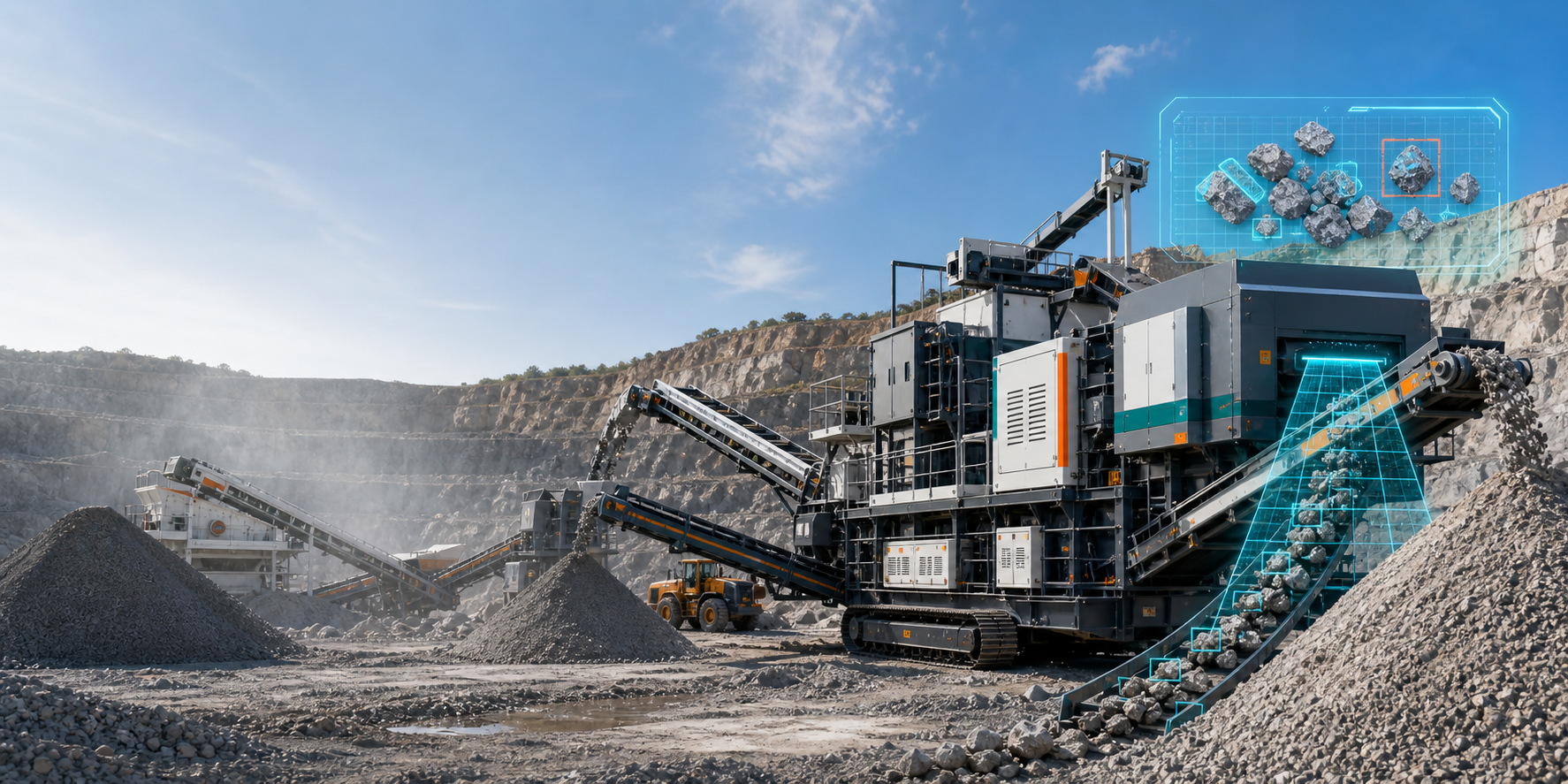
Leveraging XRT and AI vision algorithm intelligent sorting technology, focusing on three major application scenarios — intelligent waste rejection stations, tailings enrichment, and recycled sand production — to build a green value closed loop of "resource identification — value extraction — material conversion — system integration."
OVERVIEW
The mining and infrastructure industry is at a critical stage of transitioning from extensive resource development to efficient utilization and green recycling. JONO Technology deploys XRT and AI vision algorithm intelligent sorting, waste rock and tailings enrichment, recycled sand production, and intelligent waste rejection stations, achieving coordinated development of mineral resource exploitation and engineering material supply through front-end sorting and resource utilization systems.
By moving the value assessment of ore ahead of grinding, using XRT and AI vision algorithm identification for sorting, it not only reduces energy consumption and equipment wear, but also improves the overall grade of incoming materials, creating better conditions for subsequent beneficiation processes.
INDUSTRY CHALLENGES
The traditional model of relying on high-grade ore development is unsustainable, with unit output costs continuously rising.
Large volumes of waste rock and tailings are stored long-term, not only occupying land but also posing potential environmental and safety hazards.
Processes heavily dependent on water resources face mounting pressure under water scarcity and increasingly stringent environmental policies.
This leads to large amounts of ineffective material entering downstream systems, needlessly increasing energy consumption and equipment wear.
Natural sand and stone resources are increasingly depleted, making stable raw material supply and cost control more difficult.
Labor costs continue to rise and workforce stability is uncertain; the industry urgently needs to transition toward higher efficiency, lower consumption, and intelligence.
JONO SOLUTION
Addressing industry pain points, JONO Technology has built an integrated solution covering key stages of mining production and infrastructure material supply, achieving full-process optimization from resource identification to value conversion.
Introduce intelligent sorting technology based on physical feature recognition to pre-screen raw ore, effectively removing low-value or valueless materials before they enter the crushing and grinding system, significantly reducing downstream processing load.
Re-sort and enrich waste rock, tailings, and historically stockpiled materials, achieving secondary recovery of valuable elements, while converting low-value materials into manufactured sand and aggregate products directly serving infrastructure construction.
Build modular, intelligent waste rejection and sorting systems enabling continuous operation from feeding, identification, execution to discharge, supporting automatic control, data monitoring, and dynamic optimization of operating parameters.
CORE TECHNOLOGY
Powered by cutting-edge technology, achieving full-scenario ore identification coverage and overcoming multiple industry imaging and detection challenges.
Multi-energy spectrum imaging and photon counting detection work in synergy, setting multiple energy thresholds to distinguish energy-level photons, using individual photons as information carriers for precise multi-energy detection.
Scattered radiation filtering technology enhances imaging signal-to-noise ratio, overcoming challenges in imaging high-thickness materials and strengthening low-grade ore identification capability.
Leveraging full-scenario coverage algorithms to achieve precise identification of high-grade ore and keen capture of very low-grade ore.
VALUE LOOP
Precise detection via XRT and AI algorithms
Source-accurate waste rejection and waste rock enrichment
Transformation into manufactured sand and aggregate for infrastructure
Intelligent system for full-process automated operation
This closed-loop model helps enterprises reduce downstream processing costs and improve economic benefits, while achieving unified development of resource conservation and environmental friendliness.
APPLICATIONS
Through intelligent waste rejection stations, low-value materials are identified and removed upfront, reducing ineffective processing volume in subsequent crushing, grinding, and sorting systems, driving the green intelligent transformation of mines.
Introducing advanced XRF intelligent sorting systems, the equipment uses XRF spectral analysis principles combined with AI algorithms to pre-eject large volumes of low-grade waste rock, effectively improving grinding feed grade and reducing downstream ineffective processing volume.
Re-sorting and enriching waste rock, tailings, and historically stockpiled materials achieves secondary recovery of valuable elements while reducing tailings dam pressure.
By re-sorting and enriching waste rock, tailings, and historically stockpiled materials, secondary recovery of valuable elements is achieved, converting previously difficult-to-utilize low-value materials into reusable resources.
Converting low-value materials into manufactured sand and aggregate products to serve infrastructure construction, alleviating supply pressure and cost pressure caused by natural sand and stone resource shortages.
Targeting infrastructure material supply, channeling resource-based products into engineering material scenarios, achieving synergy between mineral resource development and infrastructure construction.
Mining & Infrastructure